
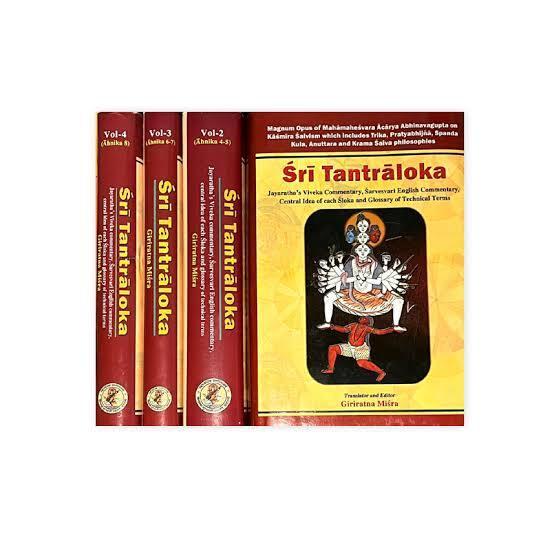


Sri Tantraloka Set of 4 Vols. Being Land of Goddess Śri Śäradā who is also known as Käśmirä – the lord of knowledge; Käśmira is eternal land of knowledge. Käśmira has always played the role of light house for the world. The might of Goddess can be judged by the fact that her abode is known to world as Sarvajña or Omniscient Pitha. Such mighty land has always manoeuvred the Indian darśanas.
Amongst various thoughts born in Kāśmira Trika, Kula, Anuttara and Krama stand tall and are corner stone of Bhartiya darśana. These thoughts make one realise that the God is no one else but self only. There are various great scriptures which help seeker realise that, however there was a need of one platform which may correlate all of them. This mighty work was done by none other than the Master of Bhartiya darśana and father of fresh ideas, Mahāmaheśvara Acārya Abhinavagupta. He wrote Śri Tanträloka which comprises of not only all the thoughts of Kāśmira Śaiva darśana rather all the darśanas of Indian thought land. His perfection in terms of sadhana and siddhi is clearly visible in his work where he has arranged all the thoughts in such a way that their hidden links are clearly visible by his grace.
This first volume comprises of Viveka Samskąta commentary and Sarveśvari English commentary of first three Ähnikas (daily lessons). The first Ahnika is Upodghäta or motto of the work called as Vijñānabheda Prakāśana Ahnika, second Ahnika is Anuttara Prakāśana Ahnika and third Ahnika is Śāmbhavopāya Prakāśana Ahnika. First Ahnika tells us that what are the basic concepts of Anuttara, Trika, Kula and Krama along with various definitions of technical terms to be used in coming Ahnikas. As the name suggests, first Ahnika also calibrates various darśanas of India on the benchmark of liberation, the supreme goal. Best is placed at first, hence the characteristics and process of earning Anupaya the Anuttara stage is mentio-ned in second ähnika which is followed by Nirvikalpa Śāmbhavopāya stage’s characteristics and practices. Mahāma-heśvara is very keen to make us attain these stages hence he doesn’t focus on any aspect other than the target. This shows that he is Guru of all with compassion and grace. This shows that he had earn the Anupāya, Anuttara Samāveśa and is a Jivanamukta. A glossary and central Idea of each śloka is added so that readers may be able to understand the subject properly before they read the Viveka or Sarveśvari commentary.